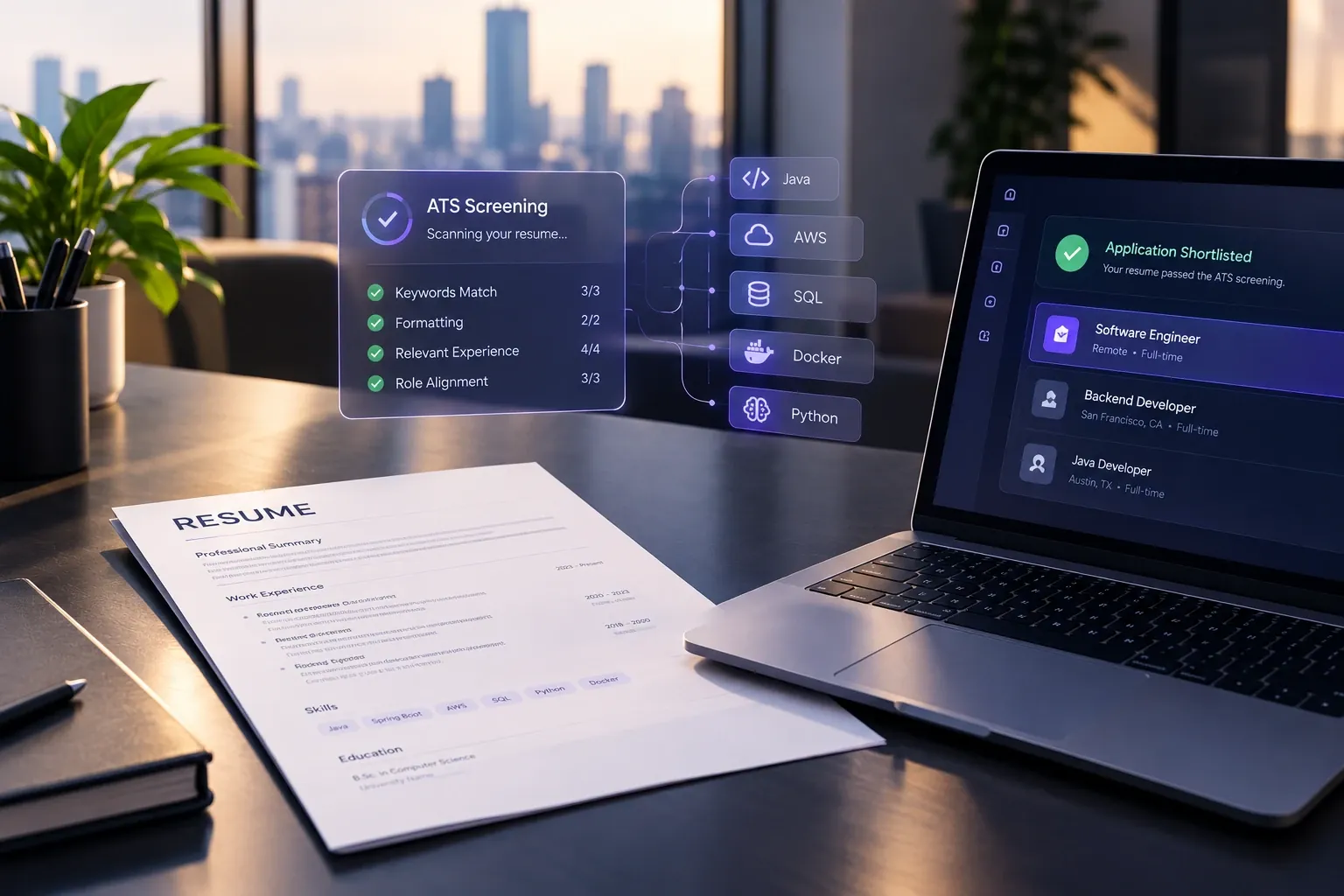
Somewhere right now, a beautifully designed resume is being turned into gibberish. Two-column layout, elegant icons, skills shown as little progress bars. The applicant tracking system reads it, scrambles the columns, drops the icons, and files a candidate whose job title has merged with their phone number.
The candidate will never know. They will just never hear back.
Most US employers, and nearly all large ones, use an applicant tracking system, usually called an ATS. Workday, Greenhouse, iCIMS, Lever, Taleo and SuccessFactors are names you may have already typed your address into. Learning how they work is one of the highest-return hours you can spend on your job search. At Placix, it is the first thing we fix for almost every candidate.
What an ATS really does (and what it does not)
There is a popular myth that a robot scores your resume and silently rejects anything below 80%. The reality is more useful to understand.
- It parses. The ATS pulls your resume apart into fields: name, contact, job titles, employers, dates, education, skills. If parsing fails, your profile looks incomplete or wrong.
- It stores and searches. Recruiters search the database with keywords and filters, much like a search engine. "Python AND Airflow," "RN AND ICU," "Epic certified."
- It ranks or matches, in some systems. Many platforms suggest a match against the job description, which influences who gets opened first.
- It enforces knockout questions. This is where true automatic rejection usually happens: required years of experience, location, licenses or work authorization.
So passing ATS screening really means three things: being parsed correctly, being found in a search, and looking like a strong match when a recruiter finally clicks your name.
The ATS-friendly resume format that works
You do not need an ugly resume. You need a predictable one. Here is the format we use with Placix Tech candidates across tech, data, business and healthcare roles.
- Single column, top to bottom. Multi-column layouts are the most common reason parsing goes wrong.
- Standard section headings. Summary, Experience, Skills, Education, Certifications. Creative headings confuse the parser.
- Contact details in the body, not the header. Some systems skip document headers and footers entirely.
- No tables, text boxes, icons or images. Skill bars and logos are invisible to the software.
- Common fonts and simple bullets. Calibri, Arial, Garamond or similar, 10 to 12 point.
- Clear dates. Use "Jan 2023 to Present" or "01/2023 to Present" consistently.
- Save as .docx or a text-based PDF. If the posting specifies a format, follow it exactly.
Open your PDF, select all the text and paste it into a plain text editor. If the order is jumbled or sections are missing, an ATS will probably see the same mess.
How to use resume keywords without stuffing them
Keywords are simply the words a recruiter is likely to search for. They come straight from the job description, and they fall into a few groups:
- Hard skills and tools: SQL, Tableau, Kubernetes, Salesforce, Epic, Cerner.
- Job titles: the exact title in the posting, if it truthfully describes your work.
- Certifications and licenses: AWS Solutions Architect, PMP, RN, BLS, ACLS, CPHIMS.
- Domain language: claims data, revenue cycle, clinical workflows, payment rails.
The trick is placement, not repetition. Put the most important keywords in your summary, weave them into the bullets where you actually used them, and list them cleanly in a skills section. Use the posting's phrasing and its acronym at least once, for example "Electronic Health Records (EHR)."
What you should never do is paste the job description into white text or list skills you do not have. Recruiters notice, and the interview will expose it within minutes.
A keyword gets you found. A result gets you called. Your bullets need both.
Before and after: one bullet, rewritten
| Before | After |
|---|---|
| Worked on dashboards for the sales team. | Built 12 Power BI dashboards tracking pipeline and revenue for a 40-person sales team, cutting weekly reporting time by 6 hours. |
| Helped with patient charting system. | Supported Epic EHR go-live across 3 inpatient units, training 85 nurses on clinical documentation workflows. |
| Responsible for cloud deployments. | Automated AWS deployments with Terraform and GitHub Actions, reducing release time from 2 days to 3 hours. |
Notice what changed. Each rewrite names the tool the recruiter searches for, says what you did, and proves it mattered with a number.
Tailor without losing your weekends
Rewriting your resume from scratch for every role is not sustainable. Instead, keep a master resume per job family and adjust three things each time: the summary, the top three bullets of your most recent role, and the order of your skills. That takes ten to fifteen minutes and covers most of the matching an ATS and a recruiter care about.
If you are applying widely and hearing nothing, the issue may go beyond formatting. We break that down in why you are not getting interviews after 100 applications.
A note for international candidates
Degrees and employers from outside the US sometimes confuse both software and recruiters. Add short context where it helps, such as "Infosys (global IT services, 300,000+ employees)" or "B.Tech, Computer Science (four-year bachelor's degree)." Answer work authorization questions accurately; guessing can trigger an automatic rejection. Our OPT job search guide covers this in more depth.
 How Placix helps
ATS-optimized resumes, written by people
Placix Tech builds role-specific resumes and LinkedIn profiles that parse cleanly, rank well in recruiter searches and still read like you. Placix then puts them in front of recruiters and hiring managers directly.
Book a free consultationYour ATS checklist
- Single column, standard headings, no tables or graphics
- Contact details in the main body
- Exact job title and key tools from the posting, used truthfully
- Every bullet starts with an action and ends with a result
- Acronyms spelled out at least once
- Knockout questions answered carefully and honestly
- File type matches what the employer asked for
Get these right and your resume stops disappearing. Then the real conversation can begin. When you are ready, browse open roles or explore Placix career services.